
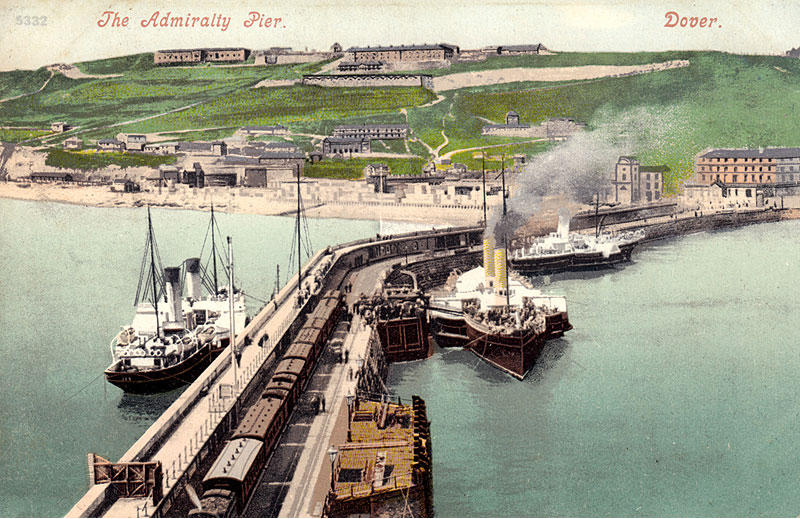
From sailing packets to steam
Until the early nineteenth century fast sailing vessels carried the mails and any passengers wanting to cross the Channel. Six years after the Battle of Waterloo the first steam-powered vessel arrived at Dover: the paddle steamer 'Rob Roy' entered the harbour on Sunday 10 June 1821 and made her first run to Calais five days later, with very few passengers. The Post Office was not convinced either and kept the mails on its sailing packets for some time. By August the local press was reporting that the 'Rob Roy' sailed daily with more passengers and carriages than any other vessel on the station, and the story of the early cross-Channel steamers runs on from there.
Steam settled the question of speed and reliability. Once the Admiralty Pier gave ships a deep-water berth in the 1850s, and the railway companies began running their trains out along it, the Dover crossing became the railway-owned mail and passenger route familiar for the next century.
Unusual vessels and the fight against seasickness
Seasickness was the great complaint of Victorian travellers, and in the 1870s Dover saw three remarkable attempts to cure it.
The 'Castalia' was launched in June 1874 and named after Lady Granville. Her designer, Captain Dicey, had observed native canoes and catamarans while Harbour Master in Calcutta, and he built her as two half hulls joined by girders, with the paddle wheels between them. At about 290ft by 60ft and 1,553 gross tons she was the largest ship yet built for the Channel service, designed to carry 700 passengers and double ended so that she need not turn in the awkward harbour at Calais. Her speed was the problem: she was so slow that she had to sail before the mail train arrived.
The 'Bessemer' was stranger still. Built on a principle invented by Henry Bessemer, she had a saloon 70ft by 35ft hung inside the hull and worked by hydraulic gear, meant to stay level while the ship rolled. She managed only 11 knots against the promised 20, demolished 50ft of the west pier at Calais on a public trial in May 1875, and was laid up shortly afterwards. The company was wound up in 1876 and the ship was sold for scrap in 1879, although her saloon survived ashore as a billiard room.
The 'Calais-Douvres', a twin-hulled development of the 'Castalia' with far more powerful engines, came closest to success. She entered regular service in July 1878, and in her first season upwards of 55,000 passengers crossed in her. Burning some 40 tons of coal a day, she was expensive to run and was withdrawn in 1888.
Turbine steamers and the boat train era
The 'Queen', launched by William Denny and Brothers of Dumbarton in April 1903, was the first turbine steamer built for the cross-Channel service and entered service between Dover and Calais that June. In the First World War she evacuated refugees from Ostend, became a troop transport and rescued over 2,000 people from the torpedoed French vessel 'Amiral Ganteaume'. She was sunk by German destroyers off Folkestone on 26 October 1916.
The Southern Railway's 'Canterbury' was built as the ferry link for the luxury Golden Arrow service between London and Paris, and she entered service between Dover and Calais on 15 May 1929. At first she carried only 400 first-class passengers, with two suites, 18 private cabins, a restaurant and a palm court. The Depression soon ended first-class-only travel, and after a refit in the winter of 1931/32 she carried 1,400 passengers in two classes. She made five trips to Dunkirk in 1940 and took part in the D-Day landings.

Car ferries: the 'Forde' and the 'Autocarrier'
Motorists were the next market. In 1928 Captain Townsend began a car ferry service from the Camber at the eastern end of the harbour, at first with a small chartered collier. In 1930 his 'Forde', rebuilt from the Royal Navy minesweeper HMS 'Ford', entered service with a stern door that folded down onto the quay, though cars still had to be loaded by crane. The Southern Railway answered with the 'Autocarrier', the first railway-owned cross-Channel car ferry, which entered service on 30 March 1930 carrying up to 26 cars.
True drive-on, drive-off loading needed adjustable bridges at both ends of the crossing to cope with the tides, and those came only after the Second World War. The roll-on roll-off terminal opened at the Eastern Docks in 1953 marked the start of the modern ferry port, while the Train Ferry Dock of 1936 carried railway wagons and the Night Ferry sleeping cars across to Dunkirk.
Hovercraft, jetfoils and Seacats
On 25 July 1959 Christopher Cockerell's SRN1 made the first hovercraft crossing of the Channel, from Calais to Dover, fifty years to the day after Blériot's flight. A regular passenger hovercraft service from Dover began on 1 August 1968, when the SRN4 'Princess Margaret' opened the route to Boulogne from a new hoverport at the Eastern Docks. A second SRN4, the 'Princess Anne', opened a Calais route in 1969, and in 1978 the hovercraft moved to a new hoverport beside the Prince of Wales Pier.
Fast craft of other kinds followed. Boeing jetfoils ran from Dover to Ostend from 1981, and fast catamarans known as Seacats started from Dover in July 1991. When the ageing hovercraft were withdrawn in October 2000, Seacats took over their Calais service, which ended on 7 November 2005.
The Dover lifeboat and the 'Herald of Free Enterprise'
Not every ship in Dover's story was a ferry. The town's first lifeboat was provided in 1837 by the Dover Humane Society, and the station came under the Royal National Lifeboat Institution in 1855, crewed then as now by volunteers. Far older than any of them is the Bronze Age Boat, found in the town in 1992 and evidence of Channel seafaring some 3,500 years ago.
The worst day in the modern ferry trade came on 6 March 1987, when the roll-on roll-off ferry 'Herald of Free Enterprise' capsized just outside Zeebrugge after sailing with her bow doors open. 193 people died. So many local people worked in the cross-Channel trade that hardly a family in Dover was untouched, and memorial windows were placed in the church of St Mary-the-Virgin in Dover and at St Margaret's-at-Cliffe. The Herald of Free Enterprise disaster also led to lasting changes in ferry design and safety rules. The wider development of the port is told in the history of Dover harbour.