
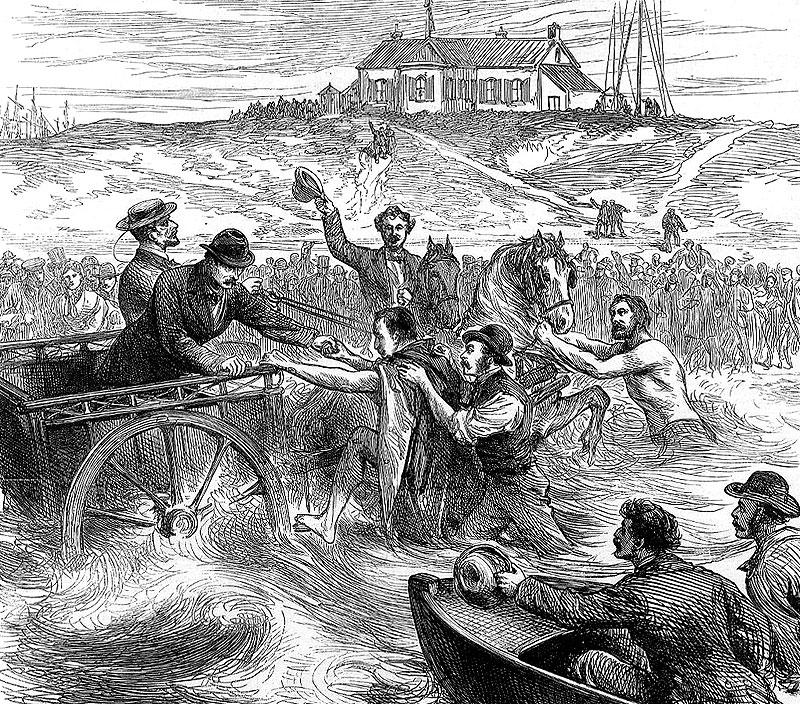
Why Channel swimming starts in Dover
The Strait of Dover is the narrowest stretch of water between England and France, about 21 miles across at its tightest point, and the chalk cliffs either side of the town are the nearest English shore to Cap Gris-Nez. That simple fact of geography has made Dover the home of Channel swimming for a century and a half. Almost every solo swim from England to France begins on a short stretch of shingle a mile or two west of the harbour, and the swimmers who attempt it spend weeks of their summer training in the town beforehand.
The swim itself is far longer than the map suggests. The tides of the Channel run north-east and south-west several times during a crossing, and a swimmer cannot fight them. Instead the pilot sets a course that lets the tide carry the swimmer sideways first one way and then the other, so the track of a successful swim usually forms a long S-shape across the Strait. A crossing of 21 miles on paper often means 25 or 30 miles in the water, and a swimmer who misses the right moment to land near Cap Gris-Nez can be swept past the headland and face hours more.
Then there is the shipping. The Strait carries one of the busiest sea lanes in the world, with ships separated into two traffic lanes running in opposite directions, and the ferries cross it again at right angles all day. A Channel swimmer crosses both lanes with nothing but a pilot boat for company, which is why no recognised swim takes place without one.
Captain Webb and the first Channel swim
The story begins with Captain Matthew Webb, a merchant navy officer from Dawley in Shropshire. His first attempt, on 12 August 1875, ended when the current carried him more than nine miles off course. On 24 August he tried again, diving from the Admiralty Pier a few seconds before one o'clock in the afternoon. He swam breaststroke almost the whole way, covered in porpoise grease against the cold, and kept going on beef tea, brandy, coffee and strong ale passed down from his support boat. He walked ashore at Calais at 10.41 the next morning, nearly 22 hours after leaving Dover, having swum something like 40 miles to cross a strait little more than 20 miles wide.
No one repeated the feat for 36 years. Webb himself drowned in 1883 trying to swim the rapids below Niagara Falls, and in July 1910 a memorial to him was unveiled on Dover seafront, where it still stands. The full story, with the earlier rescue attempt in the Atlantic that first made him famous, is on the page about Captain Webb.

The first woman to swim the English Channel
Women soon followed. On 6 August 1926 the American swimmer Gertrude Ederle swam from Cap Gris-Nez to Kingsdown, just along the coast from Dover, in 14 hours and 39 minutes. She was the first woman to swim the English Channel and her time beat every man who had made the crossing before her. The following year, 1927, the Channel Swimming Association was founded to set rules for the swim and to ratify the claims that were starting to pile up. It is still the body that records solo and relay crossings, alongside the Channel Swimming and Piloting Federation, which followed in 1999. Between them they keep the official lists of every ratified swim since Webb's.
Crossings in the other direction have stopped. Swims used to start from either coast, but the French authorities no longer permit attempts to start from their side, so today's solo swims set out from England and finish in France, and the landing has to be made on the French shore with no help from the boat.
How long does it take to swim the English Channel?
There is no single answer, because the tide, the weather and the swimmer all decide it. Most successful solo crossings take somewhere between ten and twenty hours, and plenty take longer. The fastest swimmers have crossed in under seven hours, while some determined swimmers have stayed in the water for more than a day. Webb's 22 hours stood as a benchmark for decades, and Ederle's 14 hours and 39 minutes was a record in 1926.
Distance matters less than people expect. The English Channel swim distance is about 21 miles in a straight line, but nobody swims it in a straight line, and the last mile or two near the French coast is often the hardest, when the tide turns against a tired swimmer within sight of the shore. Pilots plan swims around the neap tides, when the tidal streams are weakest, and the season runs from roughly June to September, when the sea is at its warmest. Even then the water usually sits in the middle to high teens Celsius, cold enough to make every hour count.
Relay teams make the crossing too. A relay team of up to six swimmers takes turns of an hour each in a fixed order until the team reaches France, and many first-time Channel swimmers start that way before attempting a solo crossing.
The rules: no wetsuit, no touching the boat
The rules of a recognised Channel swim are almost as old as the swim itself and are strict. A swimmer may wear a standard swimming costume, a single cap, goggles, earplugs and a nose clip, and may grease the body against the cold, but nothing that gives warmth or buoyancy, which rules out wetsuits. The swimmer must not touch the pilot boat or any person during the crossing; food and drink are passed across on a line or on a pole. The swim begins with the swimmer walking into the sea from dry land on the English shore and ends only when the swimmer climbs clear of the water on the French side, with no sea beyond.
Every recognised swim is accompanied by a licensed pilot boat and an independent observer, who logs the swimmer's progress and confirms that the rules have been kept. Pilots are booked long in advance for a tidal window, and a swimmer may wait several days in Dover for the weather to settle before the pilot calls to say the swim is on, often in the middle of the night.
Shakespeare Beach and Samphire Hoe: where Channel swims start
Webb dived from the Admiralty Pier, but modern swims start from a beach. Most set off from Shakespeare Beach, the quiet strip of shingle below Shakespeare Cliff just west of the Western Docks, where the pilot boat waits offshore while the swimmer wades in. Others start from Samphire Hoe, the country park further west built at the foot of the cliffs from Channel Tunnel spoil. Either way, the first sight a Channel swimmer has of the crossing is the white cliffs dropping away behind.
The finish is usually on or near Cap Gris-Nez, the headland that sticks out furthest towards England, though tides can push a swimmer well along the French coast before a landing is possible.
Dover harbour, where Channel swimmers train
For weeks before their swims, Channel swimmers train in Dover harbour off the town beach. Through the early summer, on weekend mornings, swimmers from all over the world can be seen swimming long laps of the enclosed water inside the breakwaters, building up the hours of cold-water swimming they will need. Many qualifying swims, the long cold-water swims required before a solo attempt, are done there too. The harbour gives sheltered water that is still the same cold sea as the Strait.
The habit of swimming off Dover beach is much older than any Channel attempt. Sea bathing came into fashion in the town in the early nineteenth century, when bathing machines lined the shingle and baths on the seafront offered hot or cold sea water. The history is on the page about sea bathing in Dover, and the beach today is described in the guide to Dover beach and seafront.

Anyone thinking of a swim of their own should remember that the harbour is a working port. Swim only in the areas set aside for it, never alone, and follow any instructions from the port and the beach. The water is cold for most of the year and the shingle shelves steeply. Current water quality information is published by the Environment Agency and the local council.
Watching a Channel swim from Dover
There is not much to see of a Channel swim from the shore, since most start before dawn and the swimmer is a speck beside a pilot boat within minutes. The best place to feel the scale of it is the cliff top. From the white cliffs walks above Langdon or from the Western Heights on a clear day, the French coast is plainly visible and the busy shipping lanes lie between, and it becomes easy to see why the swim is counted among the hardest in open-water sport. The Webb memorial on the seafront is the obvious place to pay respects to the man who started it all.
For a wider look at what the town offers, the guide to things to do in Dover brings the castle, the cliffs and the seafront together, and the history of Dover harbour tells the story of the piers that Webb dived from.