
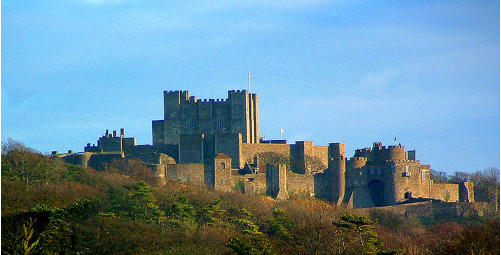
What a visit to Dover Castle covers
The castle occupies the whole of the headland east of the town, and a single admission takes in almost two thousand years of building. It has the longest recorded history of any major castle in Britain, beginning with Iron Age earthworks and a Roman pharos and ending with tunnels that were still on standby for nuclear war in the late twentieth century. Most first-time visitors underestimate the size of it. The outer curtain wall alone runs round an area big enough to hold a small town, and the walk from the car park to the far end of the cliff-top batteries takes longer than people expect.
Inside the walls a ticket covers the main areas that English Heritage opens to the public: the Great Tower built for Henry II, the inner bailey around it, the Roman lighthouse and the Saxon church of St Mary-in-Castro beside it, the medieval tunnels under the northern defences and the Secret Wartime Tunnels cut into the chalk below. The history of each part is told at length on the Dover Castle history pages; this guide deals with the practical side.
The Great Tower is the centrepiece. Built between 1180 and 1185 by Henry II's architect, Maurice the Engineer, it stands 83 feet (25.3m) high and just under 100 feet (30m) square, with walls up to 21 feet (6.5m) thick. Its interior has been recreated as it might have looked in 1184, when Count Philip of Flanders came to visit, so the rooms are furnished and hung rather than bare. Close by, the pharos is the tallest surviving Roman building in Britain, and the church next to it reused Roman brick when it went up in the late tenth or early eleventh century.
Dover Castle tickets and opening times: what stays the same
Dover Castle is cared for by English Heritage, which sets the prices and the hours. Neither is printed here, because both change from season to season and from year to year, and an out-of-date figure is worse than none. The current Dover Castle tickets, opening times and any booking requirements are published on the English Heritage website, which is the only reliable source.
Some things about Dover Castle tickets do hold steady, and they are the details most worth knowing in advance. One ticket covers the site as a whole, including the Great Tower and the wartime tunnels, rather than each attraction being sold separately. English Heritage members are admitted free on showing their card. Dover Castle tickets bought on the day at the gate and those booked in advance give the same access, but on summer weekends and in school holidays the site can be very busy, and booking ahead removes the risk of a wait or a fully booked tunnel tour.
The pattern of opening times is also predictable even if the exact hours are not. In the main season from spring to early autumn the castle opens every day. Through the winter months it has typically opened on fewer days of the week, and it closes for a short period over Christmas. Anyone planning a trip between November and March should check the calendar before travelling rather than assume the gates will be open.
Last admission is usually well before closing time. Because the tunnels run as guided routes with their own start times, arriving late in the afternoon can mean seeing the Great Tower and the grounds but missing one or both tunnel visits.
Dover Castle parking and the walk up from town
The castle stands on the hill above the town on the road to Deal, and the visitor entrance is reached by car from Castle Hill Road. Dover Castle parking is inside the castle grounds, so drivers pass through the outer defences before leaving the car, which is part of the experience. On the busiest days the car park can fill. English Heritage publishes the current arrangements, including any charge and the provision for blue badge holders.
Walking up from the town is perfectly possible but steep. The usual route leaves the Market Square along Castle Street, which was laid out in the 1830s to link the square with Castle Hill, then climbs the hill road to the gate. It is not far in distance, but the gradient is sustained, and the pavement runs beside a busy road. Visitors arriving by train at Dover Priory should allow for the walk through the town centre first. From the ferry terminal at the Eastern Docks the castle sits directly above, yet there is no direct path up the cliff face, so the route still goes round by road.
The roads round the castle are narrow and largely residential, so when Dover Castle parking is full, parking in the town and walking up, or arriving by taxi, are the practical alternatives.
How long to allow, and a sensible route round the site
A full day is the honest answer. Most visitors who want to see the Great Tower, both sets of tunnels and the grounds spend five or six hours, and families with younger children often stay longer because of the space to run about on the banks and lawns. A visit squeezed into two or three hours is possible but means choosing between the medieval castle and the wartime tunnels.
A practical order is to go to the Secret Wartime Tunnels first, because their timed visits fill as the day goes on, and then to climb up through the inner bailey to the Great Tower. The bailey is entered by the Palace Gate on the south or the King's Gate on the north, both remodelled in the 1850s. After the Great Tower, the Roman pharos and St Mary-in-Castro are a short walk south-east, and from there the cliff-top paths lead towards the Admiralty Look-out, where the Fire Command Post of 1905 and the Port War Signal Station of 1914 stand on the cliff edge above the harbour.

The Dover Castle tunnels: medieval and wartime
There are two separate tunnel systems, and they are very different visits. The medieval tunnels lie under the northern defences and date from the years after the siege of 1216. They were cut to let the garrison move unseen between the castle and its outworks, and to gather troops for a surprise attack. They are rough, unlit in places and atmospheric, and they can be explored at the visitor's own pace.
The Secret Wartime Tunnels are the famous ones. They began as barracks dug into the cliff during the Napoleonic Wars, seven tunnels able to hold up to 2,000 troops, and they remain the only underground barracks ever built in Britain. In May 1940 they became the headquarters for Operation Dynamo, from which Admiral Ramsay and his staff directed the evacuation from Dunkirk; 338,000 men came back. Later in the war the tunnels held a hospital with an operating theatre, and from 1941 the main military telephone exchange for the area. In the Cold War they were enlarged again as a Regional Centre of Government, which was decommissioned in the early 1990s before parts of the system were opened to the public.

Access, the hill and the weather
Dover Castle is built on a hill, and nothing about it is level. Paths between the main areas climb and drop, the Great Tower is entered up a long external stair, and its upper floors are reached by stone spiral staircases. The medieval tunnels have uneven floors and low points. The wartime tunnels are more even underfoot, but they involve standing for the length of a tour. Visitors with limited mobility can still see a good deal, particularly the grounds, the pharos and the views, but should look at the access information English Heritage publishes before setting out.
The headland is exposed. Wind comes straight off the Channel, and a day that feels mild in the town can be cold on the ramparts. In clear weather the reward is a view across the busiest shipping lane in the world to the French coast; on a grey day the cliff edge is lost in murk and the tunnels look like the better half of the ticket.

The castle is only one of the places in Dover where the town's defences can be seen. The Western Heights on the other side of the valley hold the Napoleonic forts and the Grand Shaft, and the white cliffs walk to South Foreland starts a short drive east. Other ideas for the rest of a stay are gathered in the guide to things to do in Dover.