
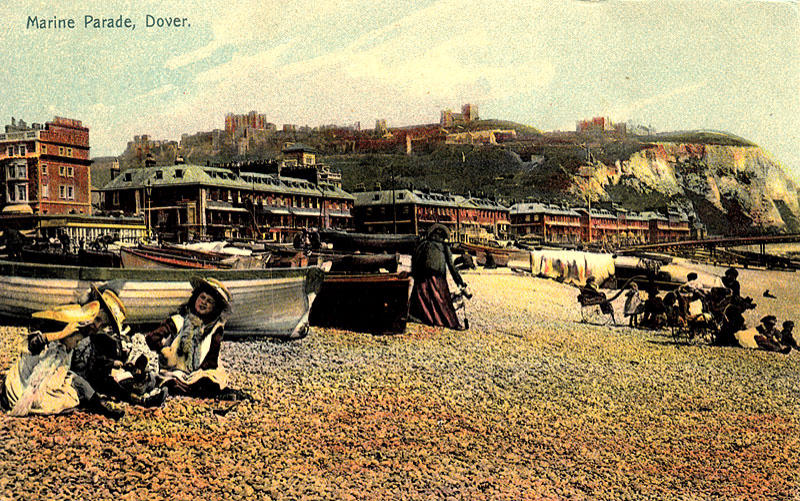
The beach inside the harbour
Dover's town beach is unusual. It does not face the open sea at all but the enclosed water of the harbour, with the Prince of Wales Pier and the Western Docks at one end and the Eastern Docks and the cliffs at the other. Ferries swing round in the harbour in front of it, and beyond the breakwaters the shipping lanes of the Strait carry on all day. It is a working view as much as a seaside one, and that is a large part of its appeal.
The beach is shingle, not sand. The bank itself is old: before 1817 the whole site of the seafront was a ridge of shingle that had begun to build up around 1500. Dover's first ropewalk ran along it, and the Town Commissioners of 1778 used it as a source of cobblestones to pave the streets. Sturdy footwear makes the beach much more comfortable, and a folding chair or a thick mat is better than a towel on the stones.
The shingle shapes the sound of the place as well as the feel of it. When the waves draw back they drag the stones with them, and the noise of that is what Matthew Arnold heard in 1851 when he wrote Dover Beach after his honeymoon, with its "grating roar of pebbles which the waves draw back, and fling, at their return, up the high strand". It is still the best description of a Dover beach on a calm night. The full poem is on the page about Matthew Arnold and Dover Beach.
Dover seafront, stretch by stretch
What locals call Dover seafront has four separate names along its length. From the Prince of Wales Pier towards the Eastern Docks the stretches are the Esplanade, Waterloo Crescent, Marine Parade and East Cliff. Building on the shingle bank was approved by the Harbour Commissioners in 1816. Marine Parade was finished by 1820, the houses on the Esplanade were begun in 1833 and Waterloo Crescent in 1834, while East Cliff was built up over the whole period and into the 1840s.
The sweeping promenade dates from 1850, when the Harbour Board began a strong sea wall along the Esplanade after the new Admiralty Pier changed the currents and started to erode the shore. The wall was carried on along Waterloo Crescent and Marine Parade, and the Borough Council built sea defences at East Cliff in 1878. The result is a level walk of the whole curve of Dover seafront, with the castle on its hill ahead when heading east and the Western Heights behind when heading west.

Several memorials stand along the promenade. Captain Matthew Webb, the first person to swim the Channel, has had a memorial on the seafront since July 1910, and a statue of Charles Rolls, who flew from Dover to France and back without landing on 2 June 1910 and was killed a month later, was put up in 1912. The Webb memorial first stood on Clarence Lawn in front of the Burlington Hotel. A third reminder of the Channel pioneers lies up the hill near the castle, where a stone silhouette of Louis Bleriot's monoplane is set into the ground at the spot where he landed after the first flight across the Channel in 1909. The Granville Gardens, laid out in 1878 on the site of the old seafront baths, were once the town's concert venue, with a bandstand and pavilion; the post-war gardens are much simpler.
The piers: the Prince of Wales Pier and the lost Promenade Pier
Two piers have stood at the western end of the beach, and only one is left. The Promenade Pier, opened in May 1893, was a true pleasure pier: 900 feet long with a pavilion at its head for concerts. It had a troubled life, rammed by a ship within six months and damaged by heavy seas in 1895, and after the Admiralty bought it in 1913 for use as a naval landing stage it never returned to the public. It was demolished in 1927.

The Prince of Wales Pier was a working pier from the start. Edward VII laid its foundation stone as Prince of Wales in 1892, and it opened in 1902 with deep-water berths that briefly brought German transatlantic liners to Dover between 1903 and 1906. Its landward section of Victorian ironwork was replaced by a solid pier in the 1970s, when the Hoverport was built beside it. For decades the pier was a favourite place for an evening walk and for sea angling.
The redevelopment of the Western Docks has changed this end of the seafront considerably, and the pier was closed to the public when work began. Which parts of the pier and the new waterfront are open, and when, is a matter for the Port of Dover, which publishes current access information on the Port of Dover website.
Sea bathing and sea swimming at Dover
Dover has been bathing in the sea for two centuries. Sea bathing became fashionable in the early nineteenth century for its supposed health-giving properties, and by the 1840s there were two bathing establishments on the seafront between Waterloo Crescent and Marine Parade, offering hot or cold sea-water baths. Bathing machines were wheeled down the shingle so that Victorian ladies could step from a little hut straight into the water. In the 1920s and 1930s a bathing station on the beach rented out changing cubicles, and the rest of the town changed under a towel. The history is on the page about sea bathing.

The link with long-distance swimming began in August 1875, when Captain Webb dived from the Admiralty Pier and reached Calais nearly 22 hours later. Ever since, Dover has been the starting point for Channel swims, and in summer swimmers in training are a familiar sight in the harbour off the beach. The history, the rules and how long the swim takes are covered in the guide to Channel swimming from Dover.
Anyone thinking of swimming should treat the harbour with respect. It is a working port with ferries, pilot boats and other craft moving about, the water is cold for much of the year, and the shingle can shelve steeply so that the depth increases quickly a short way out. Swim only in the areas set aside for it, never alone, and check any notices on the beach. This guide makes no claim about current water quality; the classification and any advice against bathing are published by the Environment Agency and the local council and can change during the season.
Trains, regattas and the lifeboat: the seafront's working past
The promenade has rarely been just a place for a stroll. From 1918 until 1964 a single-track railway ran along it, linking the Prince of Wales Pier with the Eastern Docks. It was laid by the Admiralty to carry military supplies, and after the First World War it carried coal and scrap. Because the line ran along the public road, the trains moved at walking pace behind a man with a red flag, and the coal dust brought endless complaints from residents and hoteliers. Cars parked across the rails finally finished it off. The story is told on the page about the Promenade Railway.
The seafront was also where the town came out to watch. Regatta days drew crowds onto the beach and the Promenade Pier in the years before the First World War, and photographs from the 1920s show a funfair on the front. Summer still brings sailing and rowing to the harbour, and the beach remains the best grandstand for it.
Then there is the lifeboat. Dover had its first lifeboat in 1837, provided by the Dover Humane Society and kept in a boathouse on the seafront, and the station came under the RNLI in 1855. It has closed and reopened several times, most recently in May 1947, and it has been crewed by volunteers throughout. The history, including the station's part in the Dunkirk evacuation, is on the page about the Dover lifeboat.
West of the Western Docks, below Shakespeare Cliff, lies a second and much quieter stretch of shingle, Shakespeare Beach, for anyone who wants the stones without the town.
Making the most of a seafront walk
A walk along the full length of the promenade, from the western end near the marina to East Cliff, takes twenty minutes to half an hour without stopping. At the eastern end, a path climbs from near East Cliff onto the white cliffs, so the seafront joins directly onto the white cliffs walks. The marina in the old Wellington and Granville Docks, which handled most of the port's cargo until the middle of the twentieth century, lies just behind the western end.
Evenings are often the best time. The ferries light up as they cross the harbour, the castle is floodlit on its hill, and the noise of the shingle carries further once the traffic has died down. More ideas for a stay in the town are collected in the guide to things to do in Dover.